
Russian classics on London stages in 2026: from Turgenev to Chekhov
Russian literature on the London stage is neither a museum exhibit nor a relic preserved for quiet contemplation. It remains a living body of work — open to reinvention, translation and renewed interpretation. The emotional tensions, symbolic landscapes and inner fractures shaped by Chekhov, Tolstoy, Dostoevsky and their contemporaries are still instantly recognisable; what evolves is the theatrical language through which these stories are told. Recent years have brought several landmark interpretations. Andrew Scott famously played every character in Vanya single-handedly. Cate Blanchett’s Arkadina in The Seagull at the Barbican became a sharp meditation on narcissism and the hunger for recognition. The Donmar Warehouse production of Natasha, Pierre & The Great Comet of 1812 generated extraordinary excitement and became one of the defining events of the season — audiences returned two, three times, and some even as many as seven.
Donmar has now announced its new season, with a major adaptation of Ivan Turgenev’s A Month in the Country at its centre. And this is only the beginning. Throughout 2026, London will host a series of theatre, opera and ballet productions drawn from Russian literature — works by Chekhov, Turgenev, Gorky, Dostoevsky, Pushkin and others. Afisha.London takes a closer look at what is already on the horizon.
This article is also available in Russian here
Boris Godunov
29 January – 18 February 2026, Royal Opera House (Main Stage)
Modest Mussorgsky’s monumental opera returns to the main stage of Covent Garden in Richard Jones’s acclaimed production. At its core is Tsar Boris Godunov, haunted by guilt over the murder of the nine-year-old heir to the throne. As famine spreads and unrest grows, Boris’s grip on reality begins to falter. Meanwhile, in neighbouring Poland, an ambitious young man senses an opportunity to seize power. Is the crown a symbol of authority — or a curse?

Mussorgsky wrote his libretto after Alexander Pushkin’s 1825 tragedy, itself shaped by Shakespearean influence. The opera unfolds against the backdrop of Russia’s Time of Troubles, when power shifted hands through bloodshed, manipulation and fear. The opera was performed in London as early as the beginning of the 20th century: in 1913, the great bass Fyodor Chaliapin appeared on the stage of the Royal Theatre as Boris Godunov. The costume from that historic performance is now preserved in London’s V&A Museum. The title role today is sung by Bryn Terfel, widely regarded as one of the greatest basses of our time, already praised for his interpretation. Tickets
Read here Fyodor Chaliapin in London: the triumph of Boris Godunov and an audience with King George V
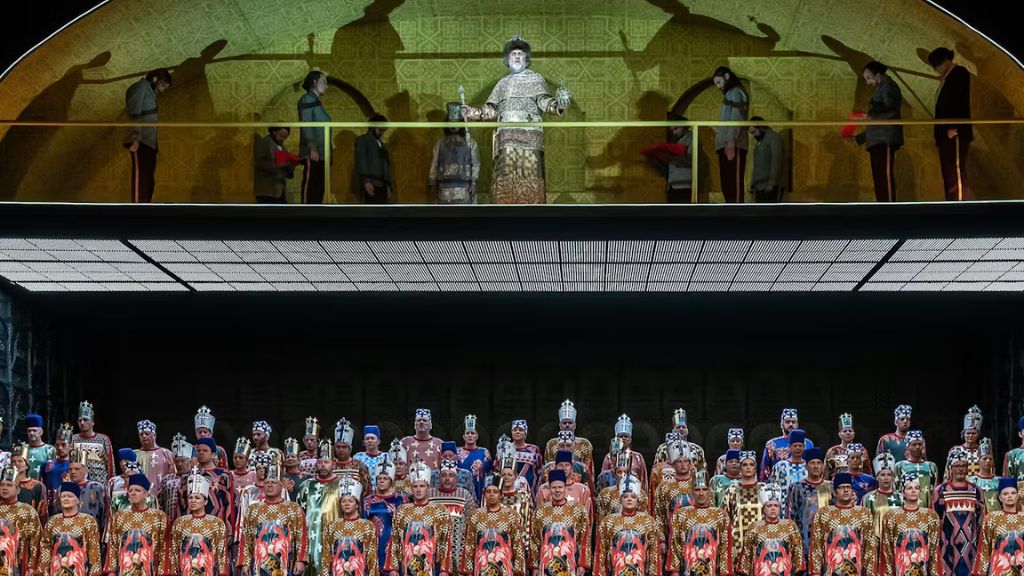
Photo: Royal Opera House
A Month in the Country
22 August – 2 October, Donmar Warehouse
Brian Friel’s adaptation of Ivan Turgenev’s play is directed by Lindsay Turner. The story explores unrequited love, provincial boredom and emotional recklessness. Natalia Petrovna, a married woman, falls for her son’s young tutor, setting off a chain reaction of desire, jealousy and disappointment.
Read also: Ivan Turgenev’s Sojourn in London: a literary ambassador between the Russian Empire and the West
Friel preserves Turgenev’s psychological realism — written some forty years before Chekhov — while sharpening its emotional precision. This is less a period piece than a finely observed study of obsession and middle-aged longing. British critics have described the adaptation as “elegant” and “wry”, with Turgenev sounding strikingly contemporary. Tickets
Production “Natasha, Pierre & The Great Comet of 1812”, Donmar Warehouse 2024-2025
Ivanov
4 July – 19 September, Bridge Theatre
Simon Stone brings a modern reimagining of Chekhov’s Ivanov to the Bridge Theatre, with Chris Pine — best known for Star Trek and Wonder Woman — returning to the stage after more than a decade away from theatre.
Following Stone’s success with The Lady from the Sea, starring Alicia Vikander and Andrew Lincoln, this production promises a sharp reassessment of one of Chekhov’s darkest and most undervalued plays. Ivanov, a man worn down by his wife’s illness, mounting debts and an unexpected attraction to a younger woman, becomes a contemporary portrait of burnout, apathy and moral exhaustion. For London audiences, it offers a rare chance to see a Hollywood actor engage with Chekhovian complexity in a psychologically intense, modern setting. Tickets

Фото: Gage Skidmore, CC BY-SA 2.0, via Wikimedia Commons
Yentl
6 March – 12 April 2026, Marylebone Theatre
After sold-out performances at the Sydney Opera House, Yentl by Kadimah Yiddish Theatre arrives in London for a strictly limited six-week run. Performed in both Yiddish and English, the production creates a distinctive bilingual experience. Although Yentl has no direct connection to Russian classics, this production may still be of interest to our readers.
Based on Isaac Bashevis Singer’s short story, the play follows a young Jewish woman in early 20th-century Eastern Europe who disguises herself as a man to study the Talmud — an act forbidden to women. Her decision becomes a point of tension between faith, tradition and personal freedom. The production examines gender restrictions, emancipation and self-discovery with emotional clarity and restraint, remaining grounded in deeply human experience. Although Yentl is not directly connected to Russian classical literature, we at the editorial team believe that this production may also be of interest to our readers. Tickets
Summerfolk
6 March – 29 April, National Theatre (Olivier)
Maxim Gorky’s Summerfolk — a sharp satire of Russia’s pre-revolutionary elite — feels unsettlingly relevant today. Set in the summer of 1905, the play portrays an aristocratic circle absorbed in romance, leisure and champagne, while catastrophe looms just beyond their field of vision.
One character, Varvara, senses that the idyll cannot last. How long can comfort shield them from reality?
Directed by Robert Hastie in a new adaptation by Nina Raine and Moses Raine, the production features an ensemble including Alex Lawther, Doon Mackichan, Paul Ready and Sophie Rundle. Tickets
Read also: Leo Tolstoy in London: shaping the British literary landscape

The Gambler
5 – 15 February 2026, The Coronet Theatre
Japanese company Chiten Theatre, led by director Motoi Miura, returns to London with a radical interpretation of Dostoevsky’s The Gambler. Performed in Japanese with English surtitles, the production plunges into a world of obsession, chance and social ambition.
Miura employs a fragmented, musical and deliberately raw theatrical language, accompanied by live music from experimental rock trio kukangendai. Critics have praised the production’s “extraordinary energy” and “deep understanding of Dostoevsky”, noting its hypnotic intensity. Tickets
Read also: Dostoevsky in London and his influence on the British classics
-
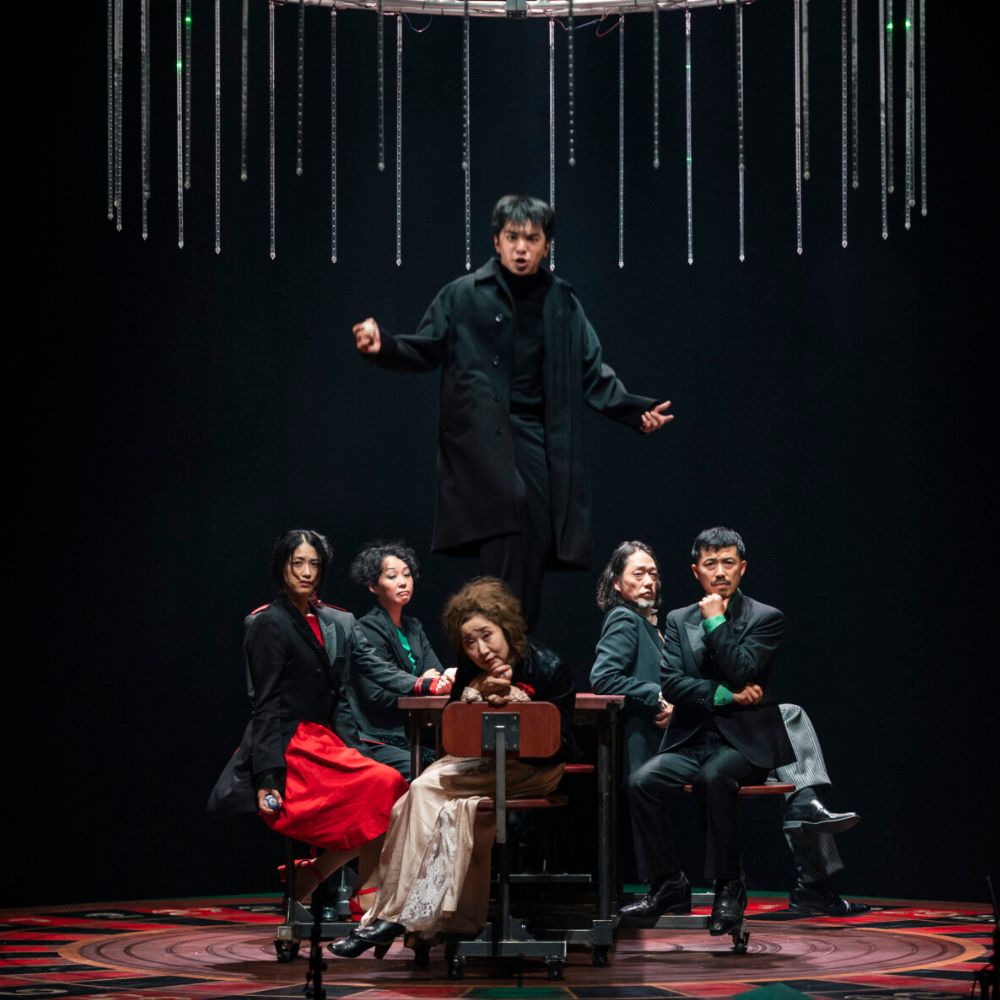
- Photo: Shotaro Ichihashi
-
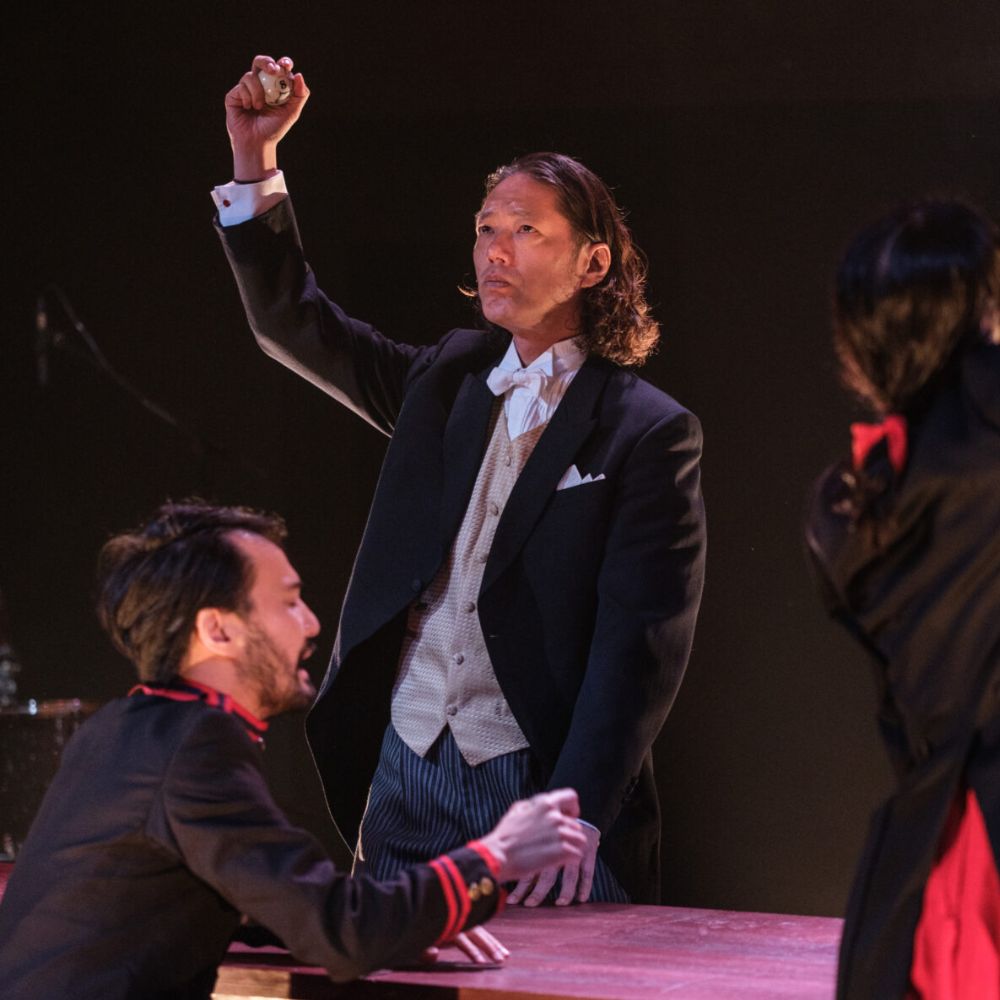
- Photo: Dimitri Djuric
The Government Inspector
20–25 March 2026 Silk Street Theatre (Barbican)
A production by Guildhall School of Music & Drama — Nikolai Gogol’s classic satire in a version by Scottish playwright David Harrower.
When news arrives that a government inspector is coming to a small provincial town, corrupt officials panic. Desperate to cover their tracks, they mistake a minor clerk for the feared visitor — and the chain of errors spirals into farce, exposing vanity, hypocrisy and greed. Tickets

Photo: The Government Inspector / Barbican
Children of the Sun
9–14 February 2026 Milton Court Theatre (Barbican)
Another Gorky — this time in a student production by Guildhall School of Music & Drama, using Andrew Upton’s adaptation first staged at the National Theatre in 2013.
Set in 1905, in the aftermath of Russia’s failed revolution, the play unfolds inside a cluttered house where intellectuals and schemers — a rising middle class — spend their time philosophising and arguing, unaware that a social storm is about to break over their heads. Gorky’s dark comedy captures a society on the edge of collapse. Directed by Vic Sivalingam. The Telegraph described the adaptation as a “tragicomic gem”. Tickets
The Cherry Orchard
10 July – 29 August 2026, Swan Theatre, Stratford-upon-Avon
The Royal Shakespeare Company revisits Chekhov’s final play in a new production directed by Tamara Harvey, with Helen Hunt as Ranevskaya and Kenneth Branagh as Lopakhin.
Adapted by Laura Wade, the play balances comedy and tragedy, capturing a society caught between nostalgia and transformation. Though staged in Stratford, a future London transfer would not be surprising for a production of this scale. Tickets
Read also: How Diaghilev’s “Saisons Russes” influenced the European art world of the 20th century
Eugene Onegin
26, 28 June & 4, 10, 12 July 2026 The Grange Festival, Hampshire
Tchaikovsky’s opera based on Alexander Pushkin’s verse novel returns in a new production directed by Max Webster at one of the UK’s most atmospheric opera festivals.
A story of unrequited love and irreversible choices. Starring Ruzan Mantashyan as Tatyana and Vladislav Chizhov as Onegin. Conducted by Lidiya Yankovskaya with the Bournemouth Symphony Orchestra. Choreography by Arthur Pita, design by Frankie Bradshaw. Tickets

Photo: The Grange Festival
Carnage and the Divine (inspired by Eugene Onegin)
Royal Opera House — premiere postponed
Akram Khan’s much-anticipated ballet, inspired by Pushkin’s Eugene Onegin, was originally scheduled for summer 2026 but has since been postponed. Following the recent success of his radical Giselle for English National Ballet, Khan planned to reimagine Pushkin’s narrative through contemporary dance, focusing on trauma, memory and unfulfilled love.
While a new date has yet to be announced, the Royal Ballet has confirmed that the project remains in development.
Cover photo: Summerfolk / National Theatre
Read also:
Behind the scenes: Olga Balakleets on reputation, trust and creating major cultural events
Fortnum & Mason: how the queen’s footman created London’s legendary emporium
London: dynamic pricing in the international theatre world triggers backlash
Related Articles

SUBSCRIBE
Receive our digest once a week with quality Russian events and articles