10 unexpected summer paintings in art, from Monet to Levitan
The seasons of nature rarely appear in painting as mere points on a calendar. What artists are usually drawn to is not temperature or weather, but that particular state of the world and the self that arrives with shifting light, air, and inner time. Summer in painting can be not only seen but almost heard: cups chime on the veranda, a thin stream of boiling water pours from a samovar, leaves rustle, bees hum above the flowerbeds, children call across a field, and the hot noon air dissolves into the sky.
Paintings of summer and summer landscapes occupy a special place in the history of art. For some artists, summer became a season of festivity and human closeness; for others, a space of silence, contemplation, and an intimate conversation with nature, and at times a setting for meditations on memory, growing up, and that fragile harmony one feels so keenly precisely because it cannot last. We are used to the most familiar summer images in art: Monet’s water lilies, seashores, sunlit gardens, and open skies. But summer can also be quieter, more inward, sometimes almost theatrical. It is precisely such works that Museum Cat has gathered here: an educational art project in London for adults and children alike, led by Margarita Bagrova.
This selection brings together Russian, European, and American painting of the nineteenth and twentieth centuries, where summer becomes not a backdrop but a protagonist in its own right: from Impressionism and the gardens of Giverny to the Russian landscapes of Polenov and Levitan.
This article is also available in Russian here

Frank Weston Benson / Summer, 1909
Frank Weston Benson was one of the leading figures of American Impressionism, a painter of delicate light, clear air, and a singular summer serenity that in his work never slips into mere decoration. His painting Summer shows a group of women on the seashore: white dresses, open wind, soft clouds, and a calm horizon create the feeling of a suspended instant, in which almost nothing happens, yet that very absence of action becomes the picture’s central content. Benson does not paint an event, but a state: a summer day, an open space, a trusting pause between movement and silence.
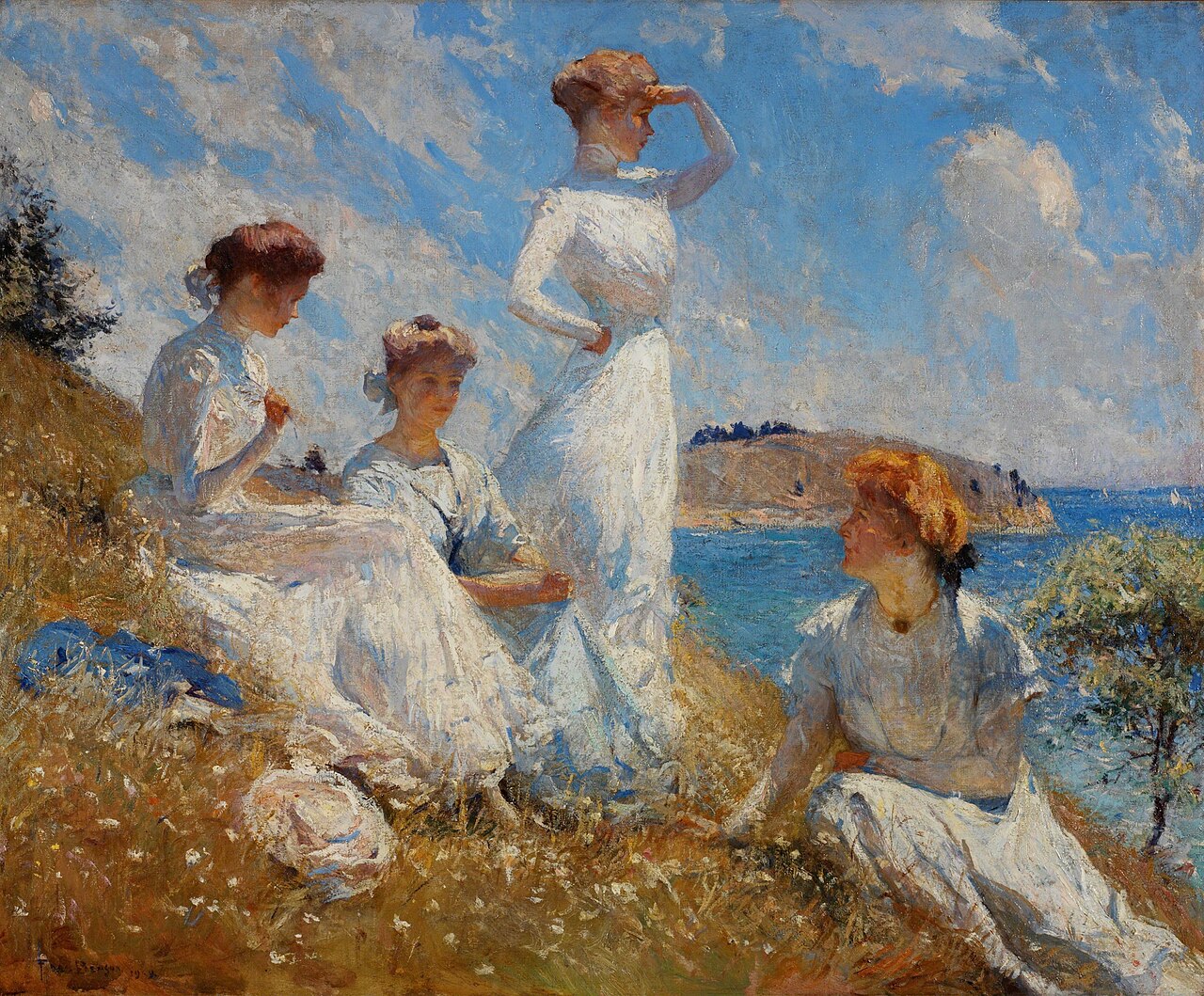
Photo: Frank Weston Benson, Public domain, via Wikimedia Commons
The white colour deserves special attention, for in Benson’s hands it is never flat or empty. In the folds of the dresses appear blue, silvery, pearly, and warm cream tones, so that the fabric seems to breathe with the sea air and the reflections of sunlight. Light here is not a decorative effect but the true protagonist of the composition. One might say that this painting belongs to a world that has not yet known the catastrophes of the twentieth century, and for that reason it now feels like a memory of a fragile pre-war harmony.

Boris Kustodiev / Summer Landscape, 1923
Boris Kustodiev is known to almost every admirer of Russian art, though this particular work may not be the first to come to mind. We tend to associate him with merchants’ wives, fairs, and the festive theatre of Russian life, yet in his painting there is always not only joy, but also a complex undertone of memory. He painted Summer Landscape for the exhibition of Russian art in America, which opened in New York on 8 March 1924. The work presents a collective image of Russia: a high riverbank, church domes, strolling figures, fairground tents, and a vast sky that occupies nearly the whole composition. There is no single central event, because life itself becomes the celebration — many-voiced, slightly naïve, and at the same time astonishingly well orchestrated in pictorial terms.
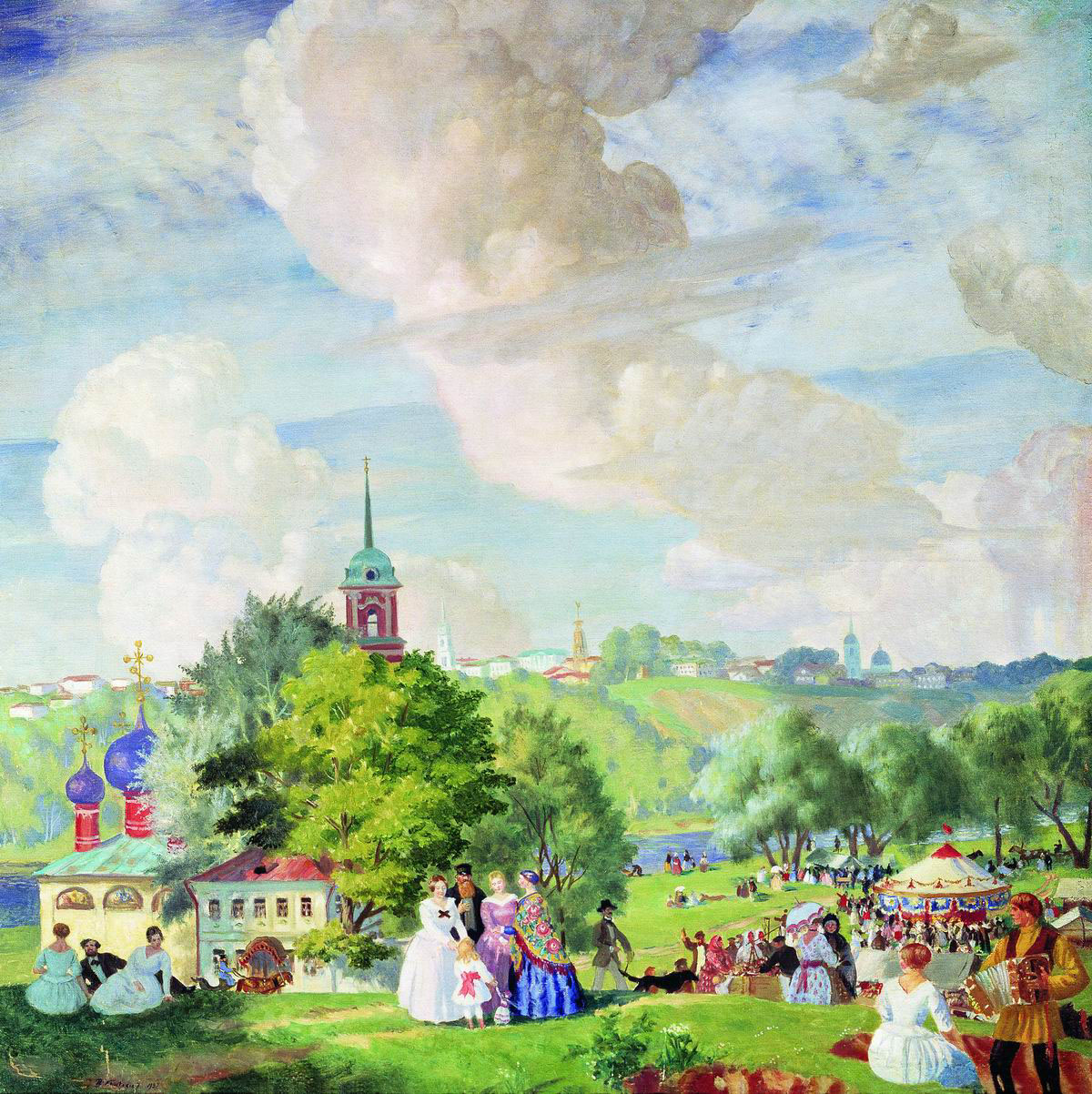
Photo: Boris Kustodiev, Public domain, via Wikimedia Commons
In his later years Kustodiev painted such scenes while already living with severe illness, when physical freedom had become sharply limited. That is precisely why the expansiveness of his canvases is so striking: the artist seems to build a pictorial universe in which the body may be confined to a chair, but the gaze remains free, generous, and celebratory. At the same time, this 1923 work does not reflect the realities of the post-revolutionary world surrounding him. It is a painting of longing for the joys of an earlier life — both spiritual and physical.

Konstantin Korovin / At the Tea Table, 1888
Konstantin Korovin belonged to those artists for whom painting was прежде всего an art of light, air, and immediate sensation. In late nineteenth-century Russian art he became almost revolutionary: his free brushwork, love of plein air painting, and rejection of academic heaviness brought him close to the French Impressionists, though he was never their direct follower. At the Tea Table belongs to the artist’s early mature period: we see a summer veranda, a laid table, a white tablecloth, a samovar, and figures engaged in an ordinary, almost domestic action.
Read also: Fortnum & Mason: how the queen’s footman created London’s legendary emporium
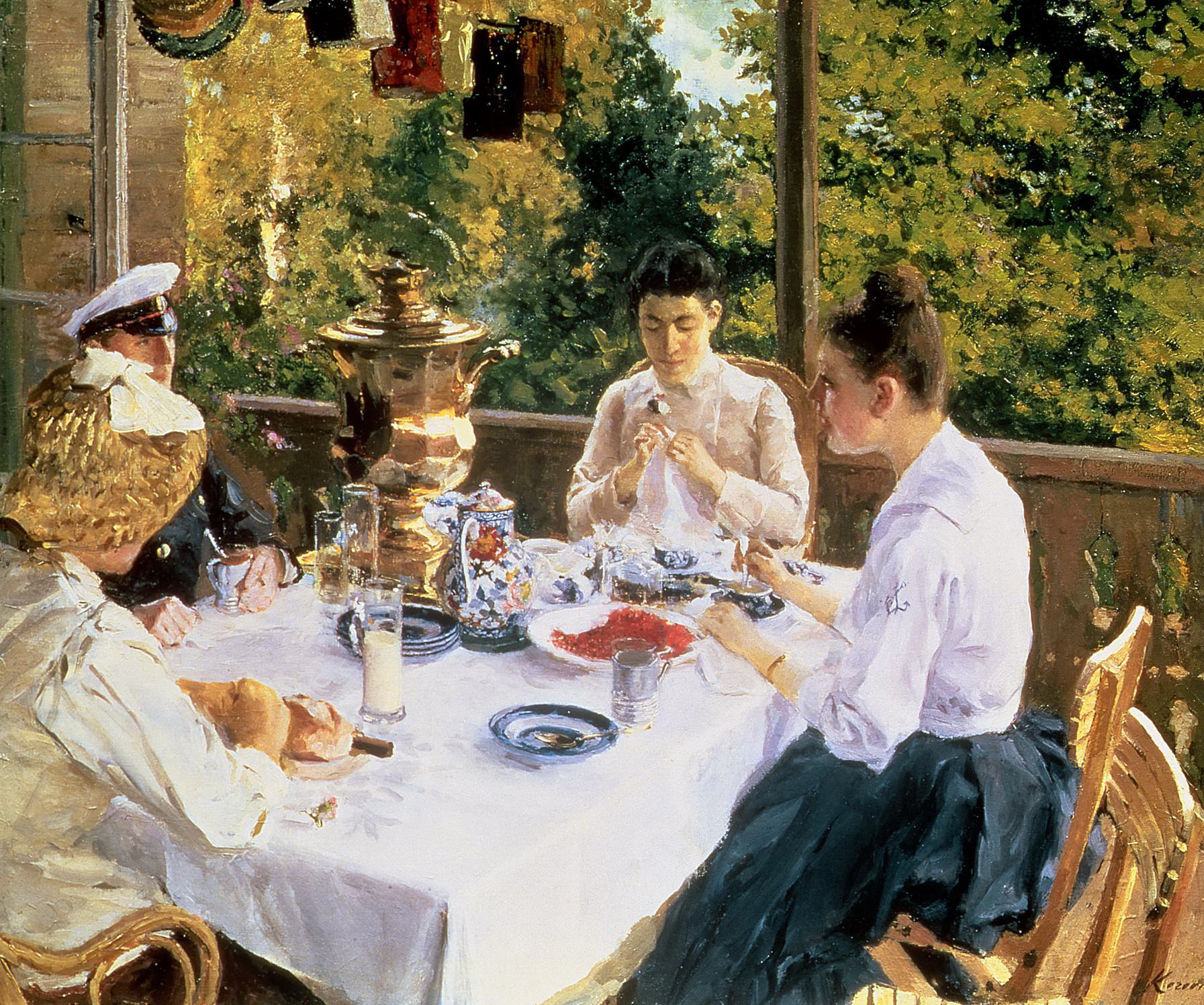
Photo: © Музей-заповедник В.Д. Поленова
The subject seems intimate and everyday, yet it was precisely in such scenes that Korovin revealed the central theme of his work: not the event, but the quality of a lived moment. In Russia at the end of the nineteenth century, the dacha culture had become an important part of urban life, and the country house, the garden, and the summer veranda turned into spaces of rest, conversation, and temporary release from the city’s rhythm. Korovin sensed this atmosphere with great subtlety and translated it into a pictorial language held together not by narrative, but by the breathing of light.
The chief virtue of the painting lies in its remarkable materiality. Korovin does not simply depict objects; he shows how they interact with light: the samovar’s metal glimmers, the white cloth gathers sunlit reflections, glass and porcelain come alive in shifting glints, and the air between the figures seems almost tangible. Summer in this work is not associated with spectacular landscape or decorative abundance; it is born from the sensation of time suddenly ceasing to hurry.

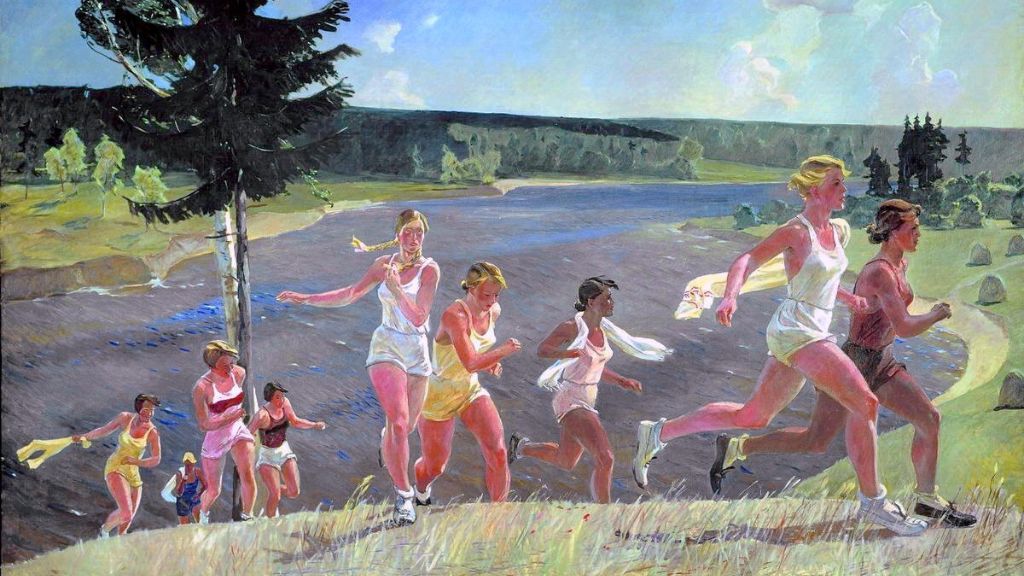
Alexander Deineka / Expanse, 1944
Alexander Deineka is usually associated with the industrial age, sporting aesthetics, and the new visual language of Soviet art. Yet behind that familiar image stands a painter far more complex, subtle, and inwardly lyrical than is often assumed. Expanse, created in 1944, appeared during one of the darkest periods in European history, and against that background the image of open space, water, wind, and human movement acquires an exceptional emotional force.
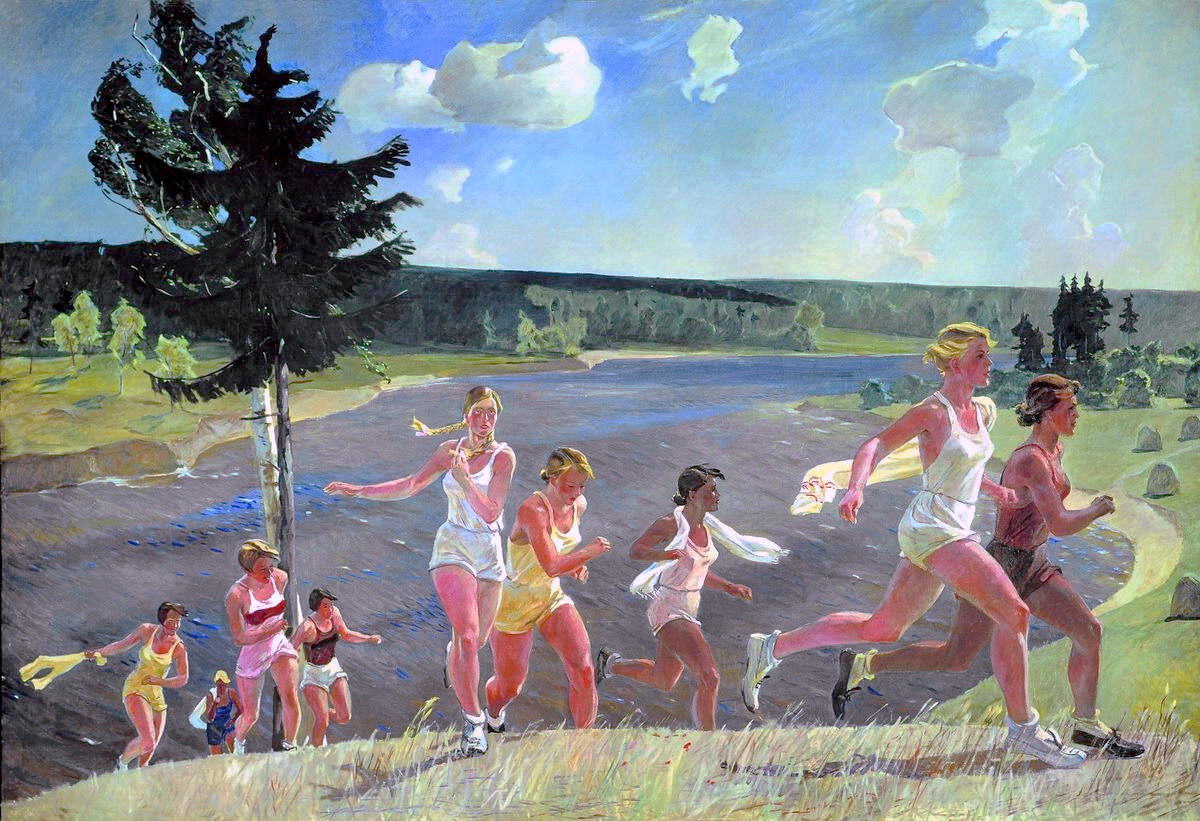
Photo: © Русский музей
We see several running figures, caught by the summer air and a swift rhythm of motion. The scene may appear simple, but its structure is carefully considered: Deineka builds the composition through diagonals of movement, repeated lines, and a charged rhythm of bodies, so that the painting is almost musical in its effect. He had a deep feeling for ancient plastic form, and his figures often recall heroes from a classical relief or fresco — simultaneously modern and beyond time.

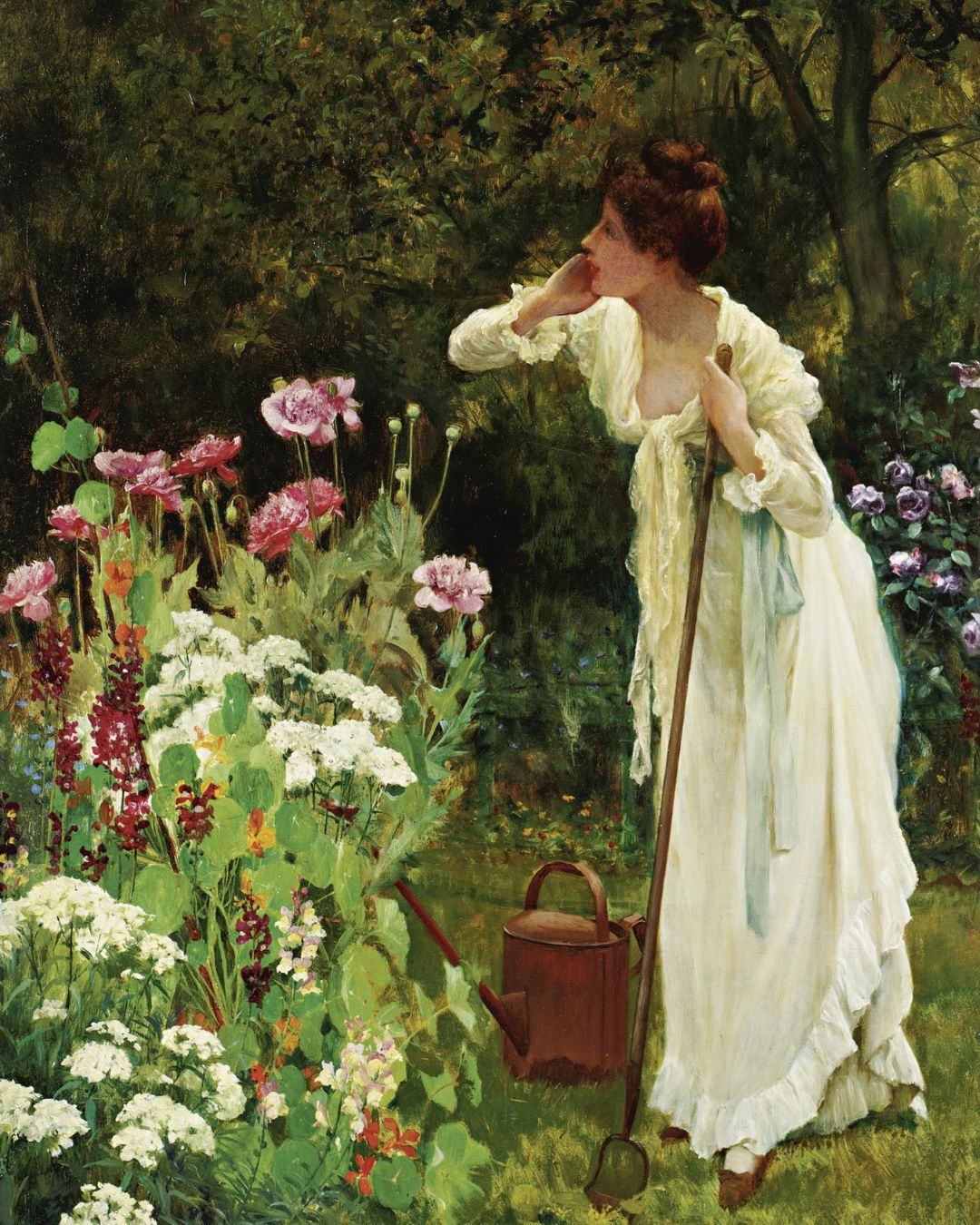
Delapour Downing / In Full Summer, 1885
Delapour Downing was an artist of Irish origin from the late Victorian period, working in Britain and chiefly devoted to intimate genre scenes. His name is far less familiar today than those of the major Victorian painters, yet artists like him allow us to see the nineteenth century not through grand historical canvases, but through the intimate life of the everyday. In Full Summer shows a woman in a garden surrounded by flowers and soft light: there is almost no action, no dramatic conflict, and no outward narrative, but that very absence of event becomes the work’s emotional centre.
In the second half of the nineteenth century, the garden in European art becomes not merely part of a landscape, but an extension of the human inner world. It becomes a place of solitude, reflection, and emotional pause. The white dress, flowering greenery, and muted light create an image of fragile equilibrium between human being and nature. The painting should be looked at slowly, allowing it to unfold not a story, but a mood.
-
- Photo: Delapoer Downing, Public domain, via Wikimedia Commons
-
- Photo: Hermann Seeger, Public domain, via Wikimedia Commons
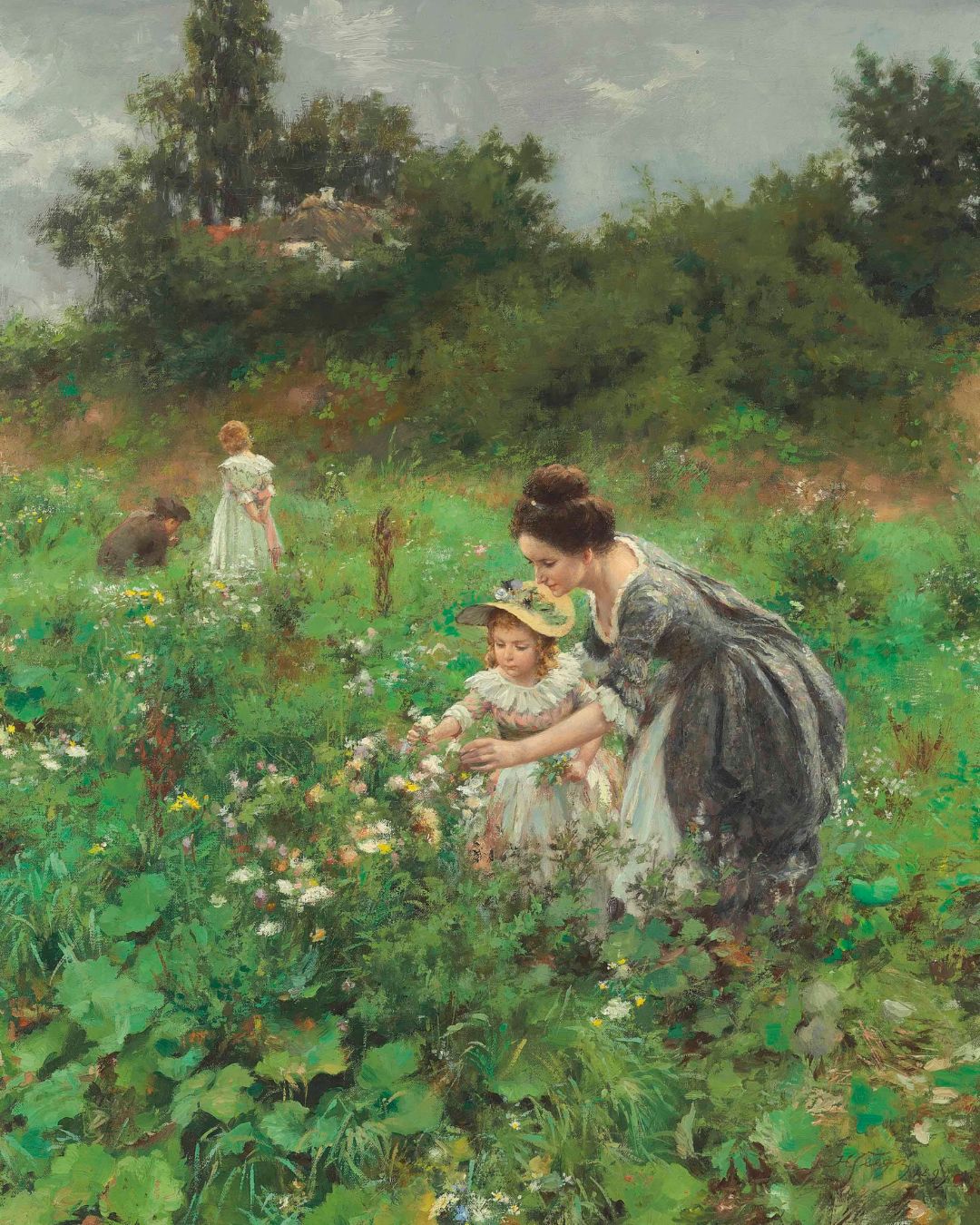
Hermann Seeger / Summer Delight, 1899
Hermann Seeger belonged to the circle of German painters of the late nineteenth century who worked at the intersection of genre painting and lyrical realism. His work is linked to the artistic culture of Berlin and the northern German coastal regions, where in his mature years he often turned to motifs of village life, family worlds, and quiet everyday scenes. Summer Delight shows a mother and child among flowers — a motif extremely popular in European art of the late realist and naturalist period.
Read also: The last Stroganov: how Hélène de Ludinghausen revived a lost Russian legacy
The painting is built on a soft harmony of green, pink, and golden tones. There is no dramatic conflict or theatrical staging here: the composition develops through gestures and glances, and a nearly imperceptible moment becomes the heart of the work. Seeger presents summer not as a season of travel or spectacle, but as a time of attentive presence beside one’s loved ones. That is where the work’s quiet strength lies: it does not seek monumentality, yet in an intimate scene it shows what human memory of summer is made of.

Charles Courtney Curran / Summer, 1906
Charles Courtney Curran was another American artist in this selection, working at the intersection of academic tradition and Impressionist sensitivity. His paintings often feature female figures, flowering hills, and scenes filled with air and light. Summer, painted in 1906, shows women among flowers and under an open sky. The subject is minimal, yet that is precisely where its expressive force lies: we are not faced with a narrative event, but with an almost idealised image of nature, in which human beings and the surrounding world exist in a state of rare harmony.
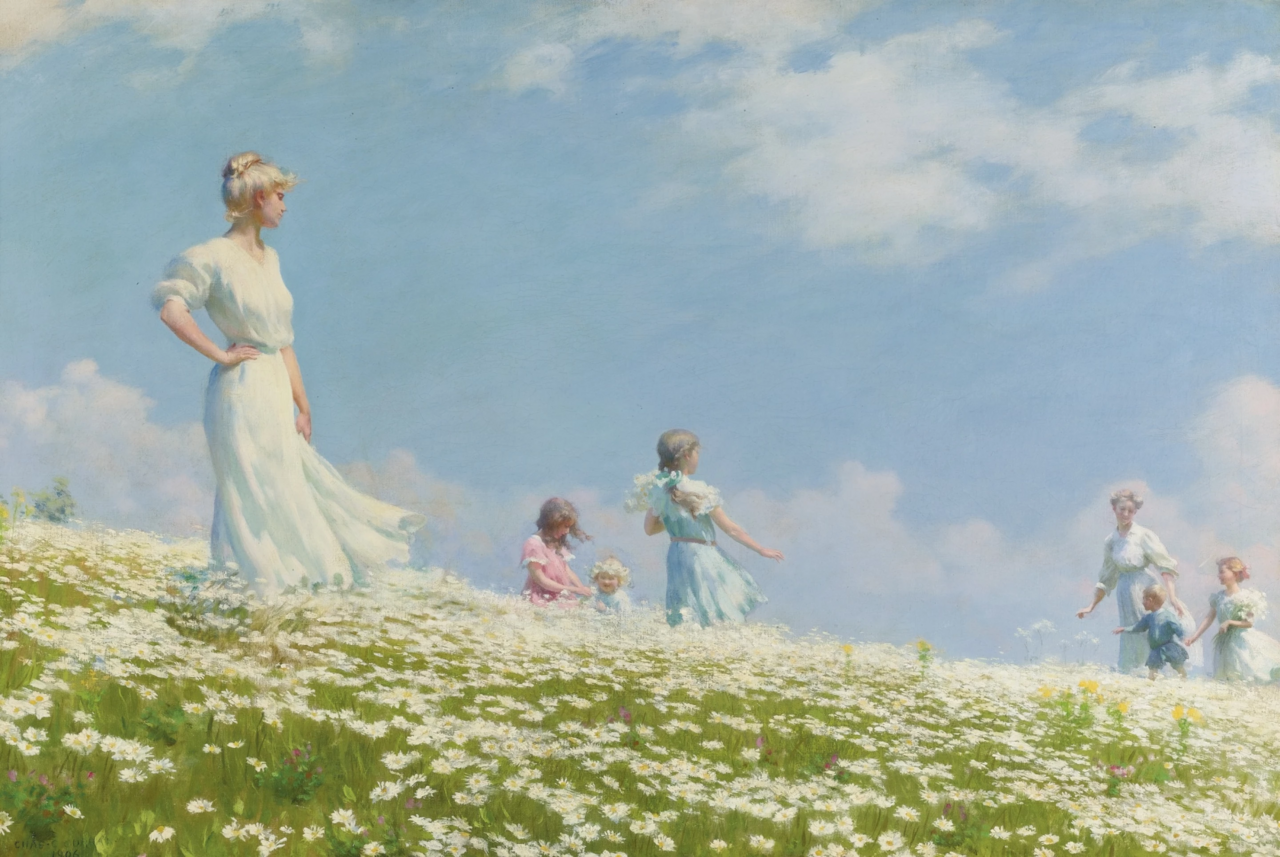
Photo: Charles Courtney Curran, Public domain, via Wikimedia Commons
At the turn of the twentieth century, American painting often sought its own version of Arcadia — an image of peaceful, beautiful life far from industrial noise. In Curran’s hands, this Arcadia is free of academic heaviness and filled with a light summer breath. Light dissolves contours, makes the scene fluid and almost dreamlike, and the painting feels astonishingly cinematic — not in a literal historical sense, but as the sensation of a slowly unfolding frame in which, in another instant, someone will pick a flower, the wind will shift direction, a cloud will move, and the summer day will continue its almost imperceptible motion. This faintly suspended movement is what makes Curran’s work so captivating: summer here is not fixed, but ongoing.
Read also: Tom Stoppard: the playwright who redefined modern drama

Vasily Polenov / The Overgrown Pond, 1879
Vasily Polenov was a painter of rare inner discipline and extraordinary spatial sensitivity. His landscapes often appear deceptively simple, yet that simplicity is always the result of finely judged composition and a profound understanding of nature. The Overgrown Pond, painted in 1879, belongs to the period of the artist’s full maturity and reveals another side of Polenov — more concentrated, almost meditative, than his celebrated Moscow Courtyard.
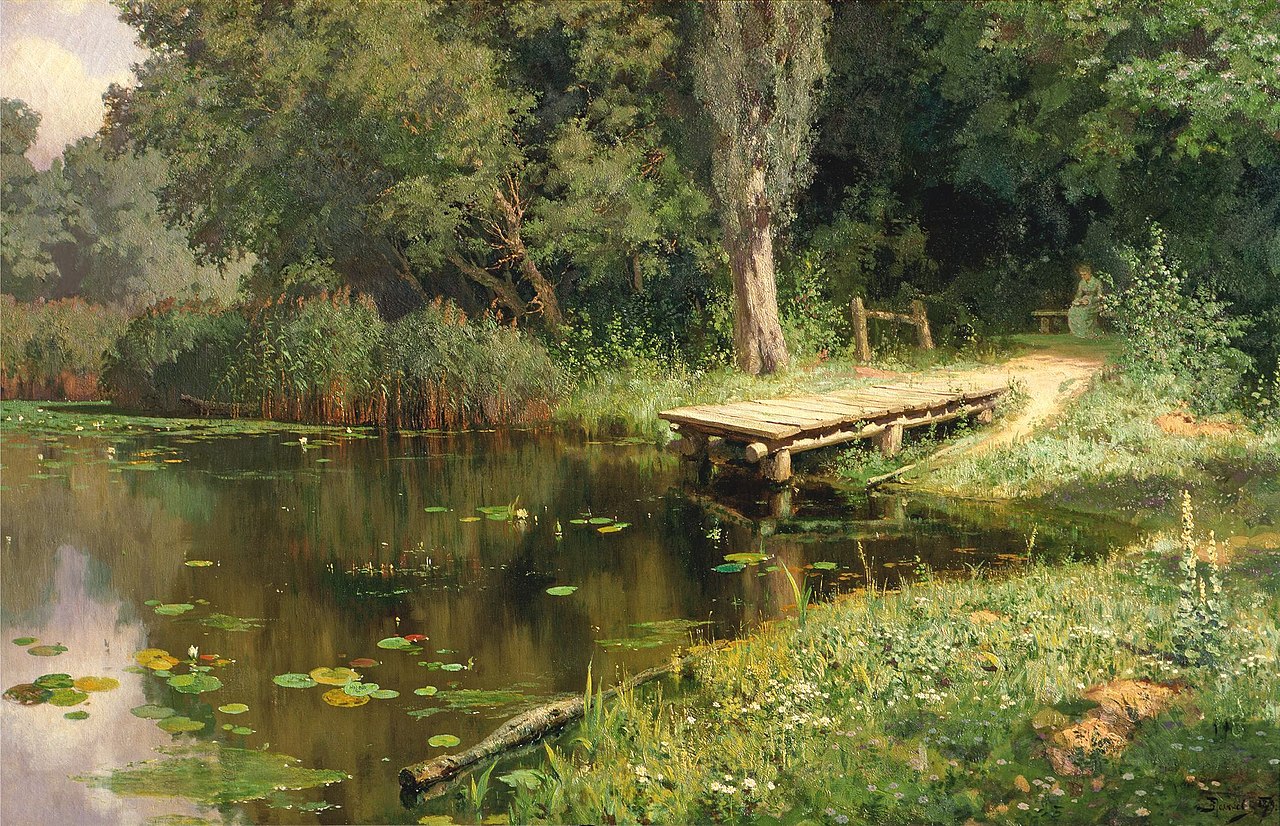
Photo: Vasily Polenov, Public domain, via Wikimedia Commons
At first glance the subject seems almost absent: a pond, wooden planks, dense greenery, and still water. Yet it is precisely the refusal of eventfulness that turns the work into a space of contemplation. In the second half of the nineteenth century, Russian landscape painting was gradually moving away from romantic theatricality toward a more intimate experience of nature, and Polenov became one of the artists who sensed this shift with exceptional clarity. The space may seem nearly empty, but it is never lifeless: one feels that a person has just left, or perhaps still lingers somewhere beyond the visible edge

Claude Monet / Path in the Garden at Giverny, 1902
Claude Monet has long since become the emblem of Impressionism, and for that very reason he can be difficult to write about: it sometimes seems as though his work has already passed into the realm of the self-evident. Yet behind the familiarity of the name is what matters most — the artist’s endless capacity to rethink a single motif, turning repetition not into mechanical reproduction, but into a fresh inquiry into light and vision. By the beginning of the twentieth century, Giverny had become for Monet not only a home, but a site of artistic experiment: the garden was created by the artist himself and gradually transformed into a living studio, where nature was at once reality, model, and a complex system of light relationships.
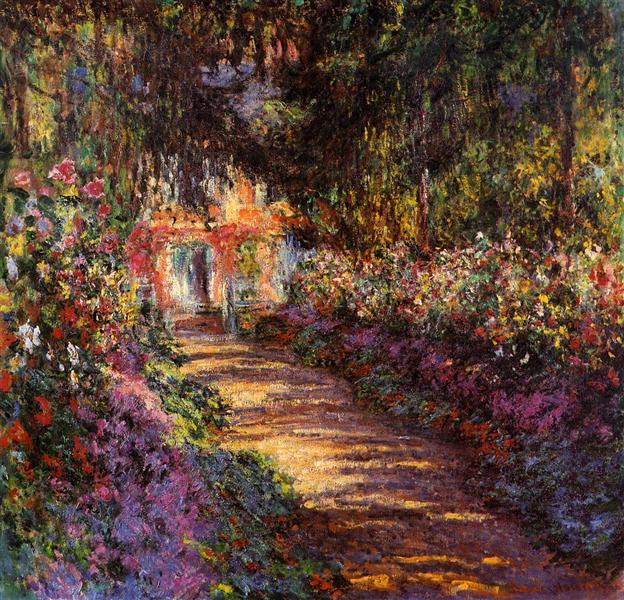
Photo: Claude Monet, Public domain, via Wikimedia Commons
Path in the Garden at Giverny, painted around 1902, belongs to the mature phase of his work. Flowers, shadows, and patches of sunlight almost dissolve familiar form, and the viewer slowly ceases to distinguish individual plants, perceiving the entire surface as a single vibrating field of colour. Monet is not interested in botanical precision or in describing the garden as a real place. His aim is far more ambitious: to render the mutability of vision and the way light quite literally reorganises the world around us. In that sense, Giverny becomes not simply a landscape, but a laboratory of human perception.
The painting’s defining feature is the absence of a stable resting point. The eye slides across the surface, lingers on bursts of colour, loses form, and finds it again. Monet’s summer is neither a plot nor a season in the ordinary sense; it is a way of seeing the world. For admirers of Impressionism and garden painting, the work offers a fresh way to look at Monet — not as a purveyor of postcards or museum souvenirs, but as a daring experimenter in colour.

Isaac Levitan / At the Dacha at Dusk, c. 1890
Isaac Levitan is one of the greatest landscape painters in the history of Russian art, a painter for whom nature became a form of psychological expression. His work cannot be reduced to the depiction of place: it always contains a state of soul, a delicate emotional vibration, and that almost elusive experience for which Russian landscape painting of the nineteenth century became a language in its own right. We remember Levitan for March, Golden Autumn, or The Quiet Abode, yet dacha scenes and twilight motifs occupy a special place in his oeuvre.
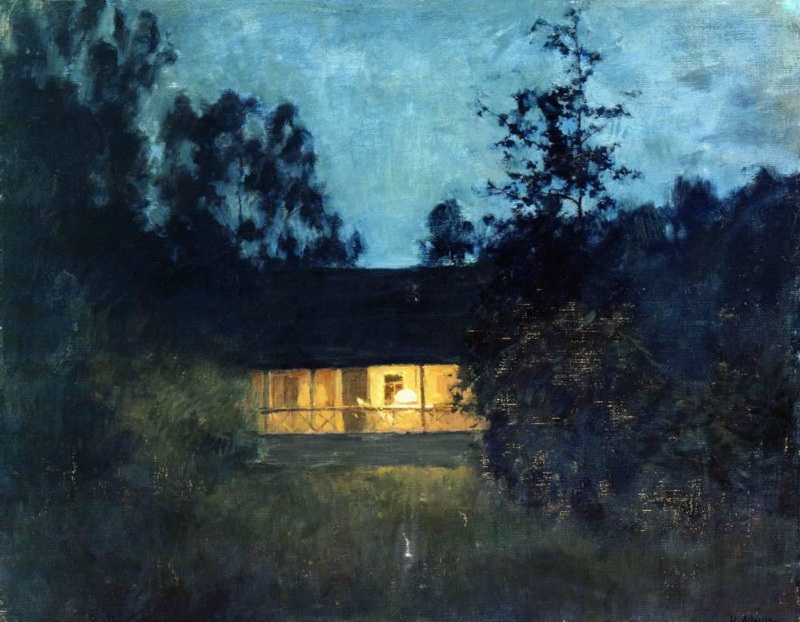
Photo: Левитан, Public domain, через Викисклад
In At the Dacha at Dusk, a house glows among the trees, and that light becomes the painting’s emotional centre. The landscape is almost devoid of outward action, but it is charged with inward tension: dusk thickens, nature grows quieter, and human habitation assumes the meaning of shelter. Levitan’s biography was shaped by wandering, illness, and a persistent search for a place in which to live and work, and for that reason the theme of home resonates especially deeply in his painting. Even without linking the work to a specific episode in the artist’s life, it still reads as a meditation on human fragility and hope.
Alexander Benois wrote of Levitan: “Levitan knew how to enjoy brush and paint; he knew not only how to paint correctly, but beautifully.” That phrase suits Levitan’s twilight summer works with remarkable precision, for their beauty arises not from brightness or decorative abundance, but from restraint, silence, and the light left in the window. For anyone interested in Russian landscape painting and the theme of summer in art, Levitan remains one of the most subtle and emotionally exact artists of his time.

Museum Cat (link to google reviews) is an educational art project in London, founded by Margarita Bagrova, offering exhibitions, tours, travel, and educational programmes in Russian since 2013. Follow on Instagram here.
Cover photo: @The State Russian Museum

Read also:
“Swan Lake”: how Tchaikovsky’s ballet became a symbol of protest
Holding on to language: the rise of Russian libraries in Britain
Ivan Turgenev’s Sojourn in London: a literary ambassador between the Russian Empire and the West
Related Articles


SUBSCRIBE
Receive our digest once a week with quality Russian events and articles